What conversations with older people taught me about listening, memory and the stories we miss
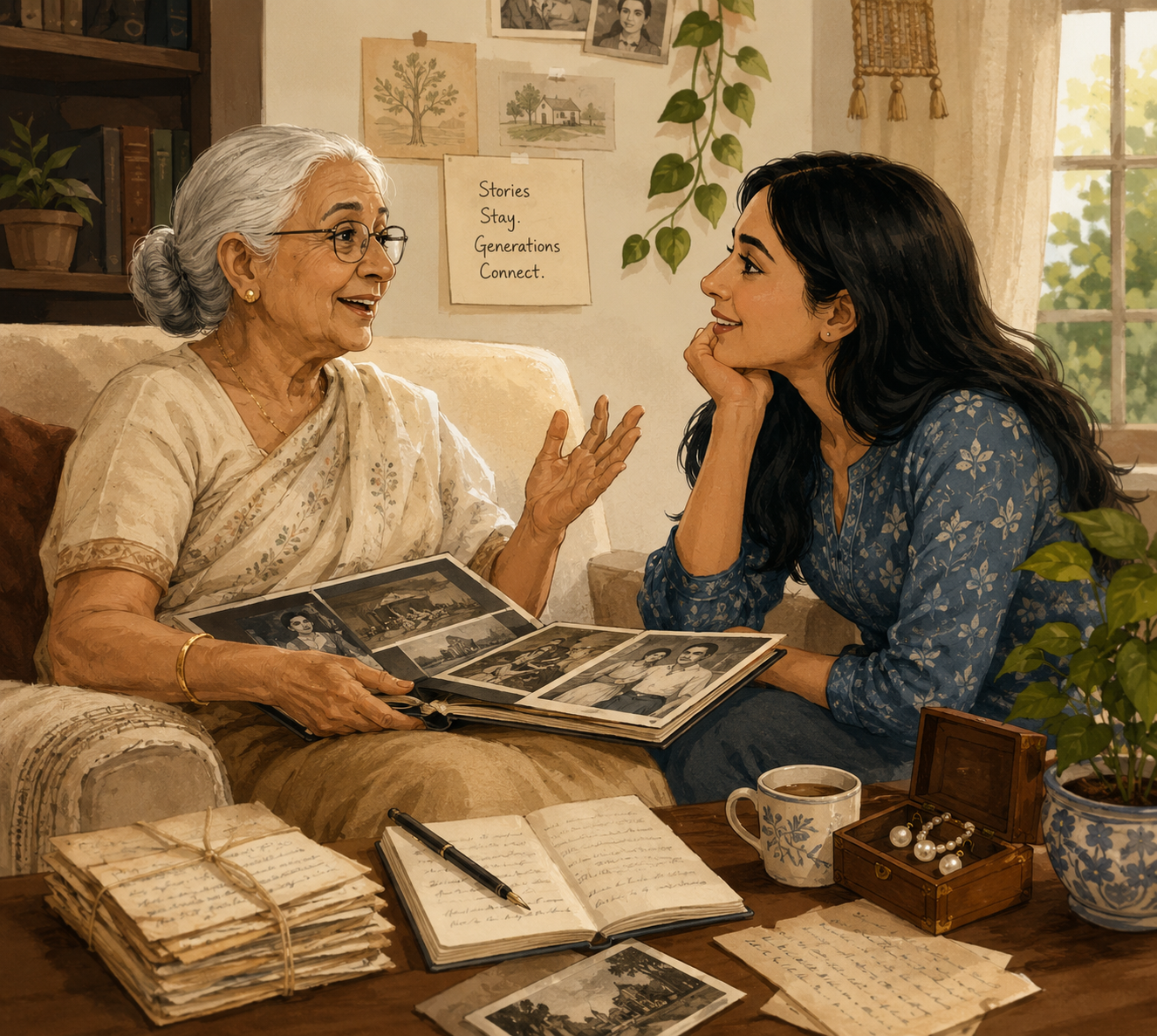
On my balcony sits a family of 20 plants that my Nani speaks to every morning. In my jewellery box are pearl drop earrings, carefully wrapped and gifted to me by my Daadi. And somewhere in my room are letters my Daadu once wrote to a pen pal, in the kind of beautiful cursive I can barely read.
I have grown up around grandparents, but The GrandStories Project also took me into the lives of other people’s grandparents — wonderful people I knew through family, friends and the conversations themselves. I thought I knew what I was looking for: childhood memories, family stories, a few funny incidents and perhaps some advice.
What I did not expect was to keep meeting entirely different versions of people I already knew.
My Nani was not always simply my Nani. She was once ‘Munni’ — climbing mango trees, playing kancha and returning home with dishevelled hair and dirty clothes. Later, she became a teacher almost by accident, fought for her first job and eventually became the head of a junior school. And then this kept happening.
Seeing Older People Beyond the Labels We Give Them
A grandfather I knew for his discipline and reliability had once been a young Air Force pilot, sitting nervously in an interview and answering “I don’t know” to three questions, only to be selected partly because he had been honest enough to admit it.
Another grandmother had started businesses, trained underprivileged women to stitch clothes and still followed the stock market with great enthusiasm. A woman I knew as calm and composed told me about travelling alone at 17, through delayed trains, rain and unfamiliar stations, and remembering it as her first real experience of independence.
None of these people had suddenly become more interesting. Their stories had simply been sitting there quietly all along.
Perhaps that was my first learning: age can make us see only the latest version of a person. We meet “grandparents”, “retired people” and “senior citizens”, but somewhere underneath those labels are young people who took risks, changed their minds, got things wrong, laughed hard, accepted challenges and figured things out.
I had simply never known to ask.
The surprising part was that the stories I remembered most were not always the impressive ones. Of course, there were careers, businesses, research, awards and all the things that look important when written down. But somehow, it was the smaller detail that stayed with me.
Ten paisa of weekly pocket money, carefully stretched over peanuts. A rose garden destroyed by stray cows after years of care. A tiny newspaper clipping with a teenager’s name printed in it — only a few centimetres wide, but kept and remembered because it made her feel seen.
Perhaps that was because these were not the stories I would have thought to ask for.
Learning to Ask Better Questions
Initially, I assumed a “good” interview meant asking good questions. I had pages of them: first job, biggest achievement, most difficult moment, best advice.
But conversations do not really work like questionnaires.
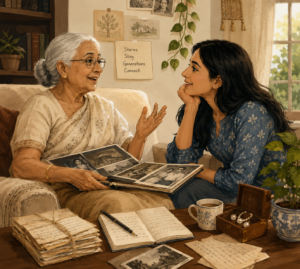
Someone would pause halfway through an answer and I would instinctively want to fill the silence. Then I realised they were often not finished, they were simply remembering. A smell, a place, someone’s face, what the room looked like, and so, I learnt to wait.
I also learnt that very broad questions usually got very broad answers. “Tell me about your life” can make anyone freeze. “What did you buy with your first salary?” is different. So is “What games did you play as a child?”, “Was there a photograph you loved?” or “What did mornings in your house smell like?” These small questions seemed to open much bigger doors.
Listening Beyond the Questions
And once those doors opened, I had to resist making the conversation about myself. I had to stop jumping in with “That happened to me too” or rushing towards the next question. Quite often, the most useful thing I could say was simply, “Tell me more.”
Over time, I began writing down what seemed to make these conversations work — asking specific questions, allowing silences, and resisting the urge to turn the conversation into a questionnaire. I eventually turned those notes into a short handbook for students and volunteers who might want to have similar conversations with older people.
I had started The GrandStories Project thinking mostly about preservation. Stories disappear, memories fade and, if no one asks, entire parts of a life can simply go undocumented. What I had not expected was how much I would carry away myself. I found myself remembering odd little things: ten paisa pocket money spent on peanuts, a destroyed rose garden that was simply replanted, a 17-year-old travelling alone through rain and delayed trains, someone answering “I don’t know” in an interview and getting the job anyway.
The Stories We Carry With Us
No one had offered any of these as advice. They had simply told me what happened, and those were the bits that stayed. Somehow, stories about other people getting through difficult, strange or uncertain moments stayed with me when I was going through my own.
I think I began the project wanting to know more about older people. I ended up knowing individual people better, and that is the part I value most now.
There are still so many stories I do not know — within my own family and in the lives of older people around me. Photographs I have never asked about, old friendships I know nothing of, jobs, journeys, embarrassments and small victories that have somehow never entered everyday conversation.
So I am still learning to ask.
This article has been written by:
Sana Gupta
A young writer who believes storytelling can bridge generations