Introduction: Curiosity Has No Age Limit
Growing older does not mean that the desire to learn, explore, or discover something new fades away. Staying mentally engaged can play an important role in supporting cognitive health, strengthening memory and maintaining a sense of purpose as we age. Curiosity is one of the most valuable qualities a person carries through life and it continues well beyond retirement. Many grandparents remain eager to understand new technology, to learn about their neighbourhood and to revisit the stories of their youth.
This guide explains how to keep that curiosity active through simple and enjoyable habits. It is written for beginners and requires no special equipment. You will find easy brain exercises for elderly puzzle lovers, memory games for senior citizens that families can play together and everyday ways to keep the mind active in old age.
Why Staying Mentally Active Matters
The mind generally responds well to regular and varied use, much as the body responds to regular movement. Researchers have often linked mental, social and physical activity with healthier ageing and a better quality of life. No single activity can guarantee protection for memory and occasional forgetfulness is common at every age. Even so, an engaged mind brings benefits that people notice, including greater confidence, a steadier mood and more to talk about with family.
Many people ask how to keep mind active in old age and the most reliable answer is to choose activities that give real enjoyment. Activities that bring pleasure are far more likely to become lasting habits.
Everyday Habits That Keep the Mind Engaged
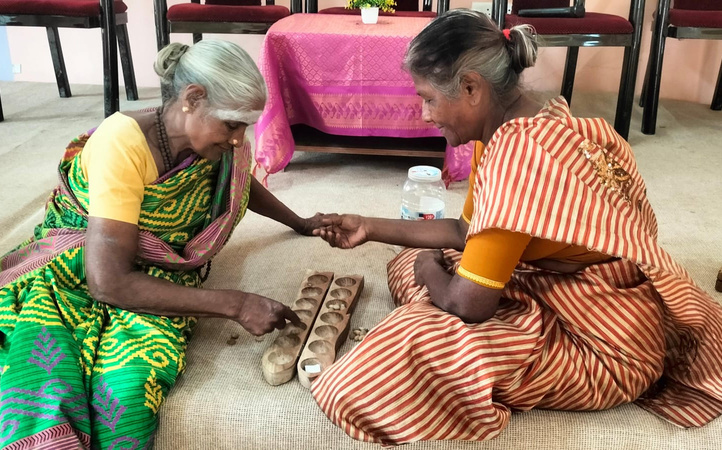
Mental activity does not need to be scheduled as a separate task, because small changes to a familiar day are often enough. Many of the most enjoyable habits are already part of home life and they are similar to the activities that elders enjoy at HelpAge India’s senior care homes, such as yoga, board games, yard work and household chores.
| Habit | What it looks like | Why it helps |
|---|---|---|
| Try something slightly different | Walk a new route to the local market or prepare a dish that you have never cooked before. | New situations encourage the mind to pay closer attention to details. |
| Play games together | Carrom, ludo, cards, mahjong or a board game with neighbours, friends or grandchildren in the evening. | Games exercise attention, planning and memory and they bring people together. |
| Practise yoga or gentle stretching | A short morning session at home, in the courtyard or on the terrace, with a doctor’s guidance where needed. | Calm, steady movement helps the body stay active and the mind feel focused. |
| Look after a patch of greenery | Water the plants, tend a kitchen garden or sweep and tidy the yard or balcony. | Caring for living things gives a daily routine and a sense of purpose. |
| Take part in home chores | Sorting pulses, cutting vegetables, folding clothes or helping to plan the weekly grocery list. | Familiar tasks keep the mind and hands active and they make elders feel valued at home. |
| Retell what you have read | Summarise a newspaper article in your own words for a family member. | Putting information into your own words strengthens understanding and recall. |
| Ask one question a day | Pick something you wonder about and look up the answer together with someone. | Curiosity is strengthened each time it is followed by a satisfying answer. |
Reading, Puzzles and Word Games
Some of the simplest brain exercises for elderly puzzle lovers are already available in the daily newspaper.
- Reading: Set aside a chapter of a book or a favourite magazine article each day and consider reading aloud to a grandchild.
- Puzzles: Sudoku, crosswords, jigsaws and spot-the-difference pictures offer a gentle challenge and the difficulty can be raised gradually.
- Word games: Word chains, anagrams and twenty questions are easy to play with family and need no preparation.
A familiar scene: Every Sunday afternoon, a grandfather brings out the old carrom board and his grandchildren gather around for a game. What started as a family tradition has become an opportunity to think, strategise, share stories and enjoy a little friendly competition.
The following memory games for senior citizens work equally well with two players or with a larger group.
| Game | How to play | What it exercises |
|---|---|---|
| What is missing? | Place eight to ten small objects on a tray, study them for one minute, then cover them and remove one item. | This game helps to strengthen attention and short-term recall. |
| Antakshari | Players take turns singing a song that begins with the last letter of the song just sung and the family can form two teams. | This game draws on long-term memory and often prompts happy recollections. |
| Shopping list chain | Each player adds one item to a shared shopping list and repeats the entire list from the beginning. | This game exercises short-term memory and careful listening skills. |
| Carrom | Players take turns using a striker to pocket coins on the board and the game is easy to enjoy with neighbours or grandchildren. | This game builds concentration, planning and steady hand-eye coordination. |
Learning Something New: A Language, Craft or Instrument
Learning a new skill requires close attention and it also offers the satisfaction of steady progress.
- A language: Learn a few new words each day with the help of a phone application or a friendly neighbour.
- A craft: Knitting, embroidery, crochet and origami can be learned at a gentle pace and produce something worth displaying like:
- Weaving small baskets or mats from jute or cane
- Painting clay diyas or earthen pots
- Stitching cloth bags from old sarees or dupattas
- An instrument: A flute, a small keyboard or a set of hand drums is a rewarding place to begin.
It is sensible to start small, because ten minutes of practice each day usually achieves more than a single long weekly session. Beginning again as a learner can feel humbling, but the progress that follows is often a source of great pride.
A familiar scene: A retired schoolteacher decides to begin learning knitting after many years of wanting to try it. Her first muffler takes several weeks and a few unravelled rows, but within a month her stitches are even enough to make warm sweaters for the grandchildren.
The Role of Social Connection
Regular contact with others gives the mind more to think about and it helps people feel valued as part of a community.
- A weekly walk or cup of tea with a friend provides both routine and conversation.
- A reading group at a local library encourages discussion and the sharing of opinions.
- Community centres and hobby classes offer opportunities to meet people with similar interests.
- Sharing a skill, for example by guiding a younger neighbour, gives a strong sense of purpose.
Community spaces such as the Active Ageing Centres listed on the HelpAge India website are designed for exactly this purpose, offering a place to meet, learn and take part. Availability varies by location, so it is worth checking what is available nearby.
Staying Physically Active and Well Rested
Health guidance for adults often suggests around two and a half hours of physical activity each week. A good routine combines aerobic activity such as dancing or swimming with strength, balance and flexibility work, for example tai chi or yoga.
Sleep is equally important, because the brain uses rest to organise the memories of the day. Most adults benefit from between seven and nine hours of sleep each night. Individual needs differ, so it is wise to consult a doctor before beginning any new form of exercise.
Making a Mentally Active Routine Fit Your Day
A routine designed to keep mind active in old age does not need to be strict and the plan below is offered as a flexible menu.
| Time of day | An easy activity |
|---|---|
| Morning | Read the newspaper or complete a short puzzle with a cup of tea, for about fifteen minutes. |
| Late morning | Spend about twenty minutes in light physical activity and afterwards try to recall three things that you noticed. |
| Afternoon | Rest for a while, then practise a new skill such as a few words, a tune or a calligraphy stroke for fifteen minutes. |
| Evening | Play one of the memory games with family, or telephone a friend for a conversation. |
| Bedtime | Reflect quietly on three pleasant moments from the day before going to sleep. |
The plan is meant to be flexible, so any day that proves too busy can simply be skipped without worry. A combination of mental, social and physical activity tends to work best and enjoyment makes the habit easier to maintain.
When to Speak to a Doctor About Memory Concerns
Occasional forgetfulness is common and usually harmless, but certain changes deserve a conversation with a doctor.
- Getting lost in a place that was previously familiar is a reason to seek advice.
- Difficulty completing everyday tasks, such as cooking a familiar meal or paying a bill, should be discussed.
- Forgetting the name of a close family member or friend is a change that warrants attention.
- Using unusual words in place of familiar objects may also be a sign worth mentioning.
Many conditions can affect memory, including low mood, poor sleep, thyroid problems, vitamin deficiencies, hearing loss and the side effects of some medicines. Some of these causes can be treated, which is a good reason to seek advice early. It helps to bring a trusted family member to the appointment, along with a list of current medicines. Seeking advice is a responsible step towards looking after one’s own health.
This guide is not a diagnostic tool and a doctor is the right person to assess any concern.
Conclusion
Curiosity has no age limit and it can be nurtured through simple daily habits at any stage of life. It appears in a crossword completed over morning tea, in a new skill learned slowly and patiently and in a story shared with a grandchild. It is not necessary to attempt everything in this guide. A better approach is to choose one habit that sounds enjoyable, such as a puzzle, a hobby or a few brain exercises for elderly learners and to practise it for a week before adding another. Memory and curiosity both tend to grow with regular use and they develop best in good company. From all of us at HelpAge India, we wish every reader a curious and engaged mind at any age.
FAQs
1. How to maintain memory in old age?
A wall calendar, diary, or written list can hold appointments and tasks, freeing the mind for other things. Focusing on one task at a time also helps, since memory is weakest when attention is divided. Memory games for senior citizens can add enjoyment to the routine, although the evidence for any single game is limited.
2. What is good for the aging brain?
What protects the heart generally protects the brain too: a Mediterranean-style diet with fruit, vegetables, nuts, seeds and fish, limited alcohol and no tobacco. Keeping blood pressure and blood sugar in a healthy range, treating hearing and vision problems early and staying connected with friends and family also help. Brain exercises for elderly learners can add to this, keeping the mind active in old age.
3. What are the changes in the brain at age 83?
There is no single pattern, because brains age at different rates and many people in their eighties stay sharp and active. Common gradual changes include slower processing speed, a little more time to recall names and words and more difficulty juggling several tasks at once. Overall knowledge, older memories and language generally remain intact in normal ageing.https://www.helpageindia.org/active-ageing-centres
4. What are some early signs of brain aging?
Early signs of normal ageing are mild and occasional, such as misplacing keys now and then, remembering a word a little later, or taking longer to learn a new device. These changes do not usually affect daily life or independence. If forgetfulness starts to interfere with everyday activities, it is worth discussing with a doctor.
5. How does HelpAge India support the health and wellbeing of elders?
HelpAge India works with elders on health, dignity and independence through programmes such as primary healthcare, vision restoration and correction, mental health, telehealth, physiocare and palliative care. Availability varies by location, so elders and families can check the HelpAge India website for what is active in their area.
This blog has been written by:
HelpAge India